“You don’t have to brush all your teeth, just the ones you want to keep,” said my childhood dentist, and that stuck with me. As I grew older, I developed an interest in social history and how people used to live in “ye olden times.” As October plays host to the king of all candy holidays, Halloween, it is also National Dental Hygiene Month.[1] We all enjoy our taffies, caramels, and chocolates, but how did people in the past take care of their oral health? Colgate and Oral B weren’t around yet, and fluoride treatments were still centuries away.
Despite the lack of running water and indoor plumbing, English colonists in North America cared very much about their health and hygiene, but their ideas of hygiene were just different from today’s norms. For example, have you ever considered brushing your teeth with a twig? How about mouthwash made from brandy? Beauty, personal care, and even basic medicine was knowledge passed down from generation to generation. But who can keep track of all these different recipes?
In 1772, French physician and botanist, Pierre-Joseph Buc’hoz, published The Toilet of Flora, a collection of recipes for medicinal and cosmetic care utilizing natural ingredients.[2] [3] Republished just a few years later in 1779, the book was a success both in Europe, and in the colonies. So, let’s crack open our copy and see what we can make.[4]
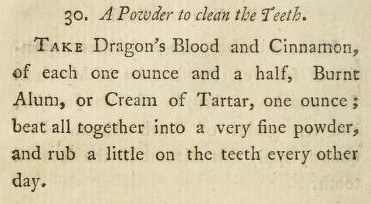
“A Powder to clean the Teeth”
Recipe from The Toilet of Flora
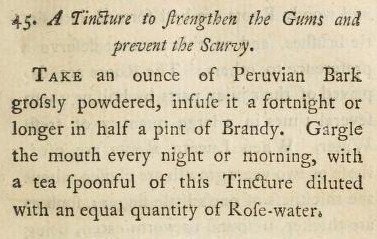
“A Tincture to Strengthen the Gums and prevent the Scurvy”
Recipe from The Toilet of Flora
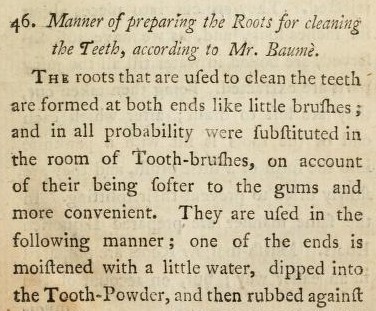
“Manner of preparing the Roots for cleaning the Teeth,”
Recipe from The Toilet of Flora
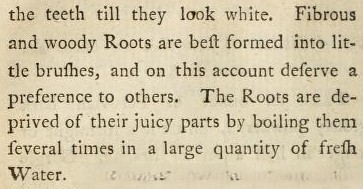
on “Manner of preparing the Roots for cleaning the Teeth,” continued
Recipe from The Toilet of Flora
Here’s what everything looks like all laid out for our recipes.
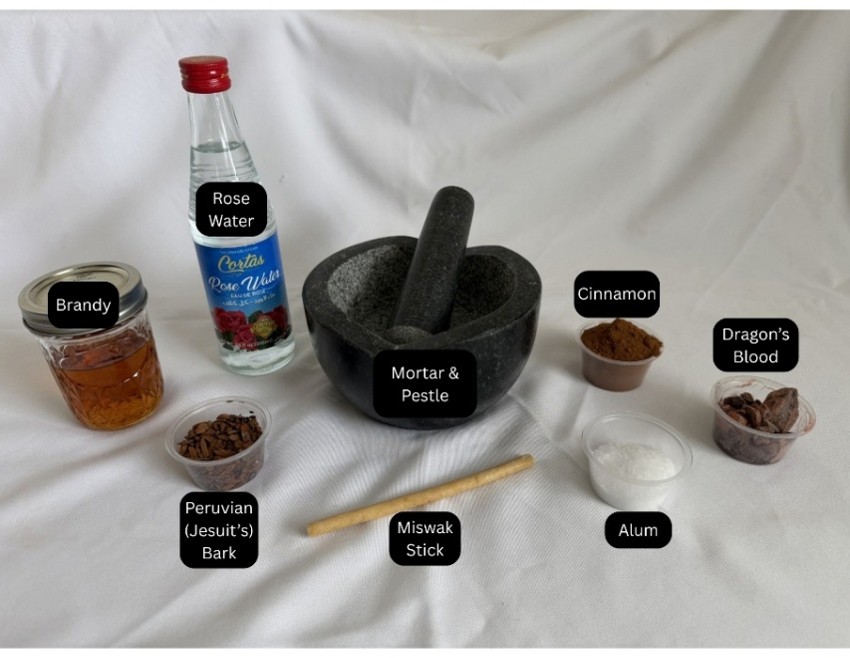
Photo: ingredients needed for recipes. Clockwise: brandy, rose water, mortar & Pestle, cinnamon, dragon’s blood, alum, miswak stick, Peruvian (Jesuit’s) bark
Much of what was needed could be found on ships from Europe. Merchants in the American colonies would import spices, drugs, medicines, and anything else one might need, then advertise their wares in the local paper. The November 19, 1772 and June 17, 1773 editions of the Virginia Gazette published by Purdie and Dixon, for instance, had such advertisements.[5] [6]
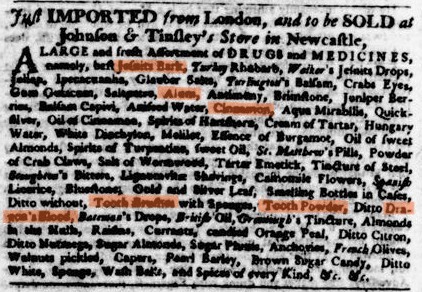
Advertisement
Colonial Williamsburg, “Virginia Gazette,” Purdie and Dixon, November 19, 1772
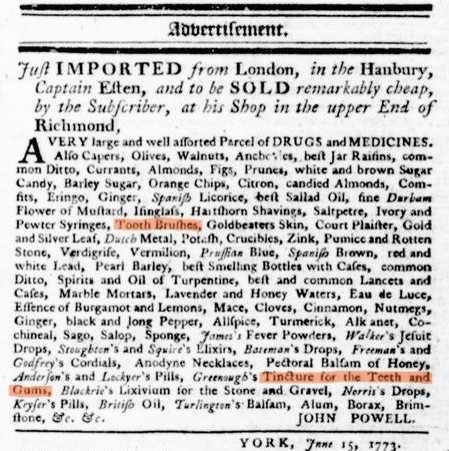
Advertisement 1773
Colonial Williamsburg, “Virginia Gazette,” Purdie and Dixon, June 17, 1773
TOOTHBRUSH
“Tooth Brushes” in the later advertisement could refer to a few things. One possibility, if you had resources, was a brush made from bone with natural bristles, like the ones excavated from Ferry Farm.
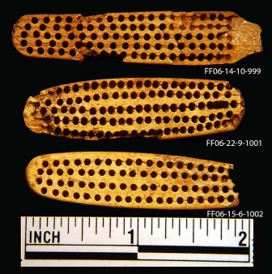
Bone toothbrush heads excavated from Ferry Farm
Recipe
Another option could be a miswak stick, or the root of the Salvadora persica. This root has been studied for its antibacterial, antifungal, and antiplaque properties, and was a cheaper alternative to bone.[7] Following the instructions written in The Toilet of Flora, let’s prepare our own miswak stick. First, soak one end in hot water for 15 minutes. Then use a knife to cut around the exterior, until more fibrous bristles can be seen. Then chew gently on the bristles until they open up. You can rub the bristles on your teeth and gums to clean them, or you can pair them with a tooth powder, which we’ll make next.
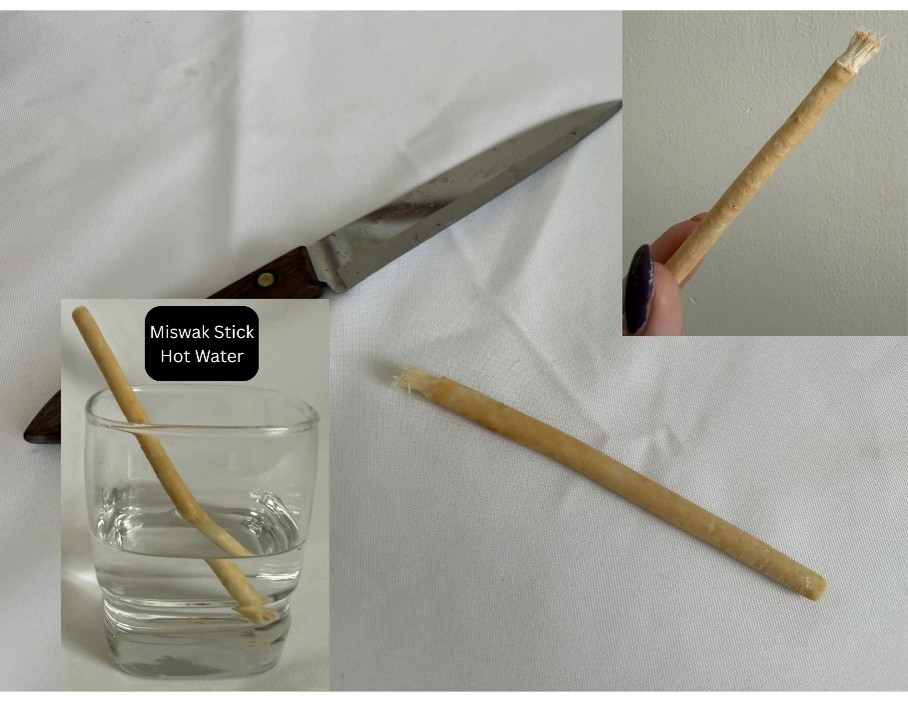
Results & Thoughts?
Honestly, it wasn’t that bad. Miswak is very herbaceous in taste, so if you’re adverse to strong flavors, this might not be for you. Also, the bristles get weak and loose after a few uses, so you will have to trim it often. Other than that, I would use this again.
TOOTHPASTE
Let’s make “A Powder to clean the Teeth.” To prepare the tooth powder, use a mortar and pestle to grind the dragon’s blood, cinnamon, and alum into a fine powder.
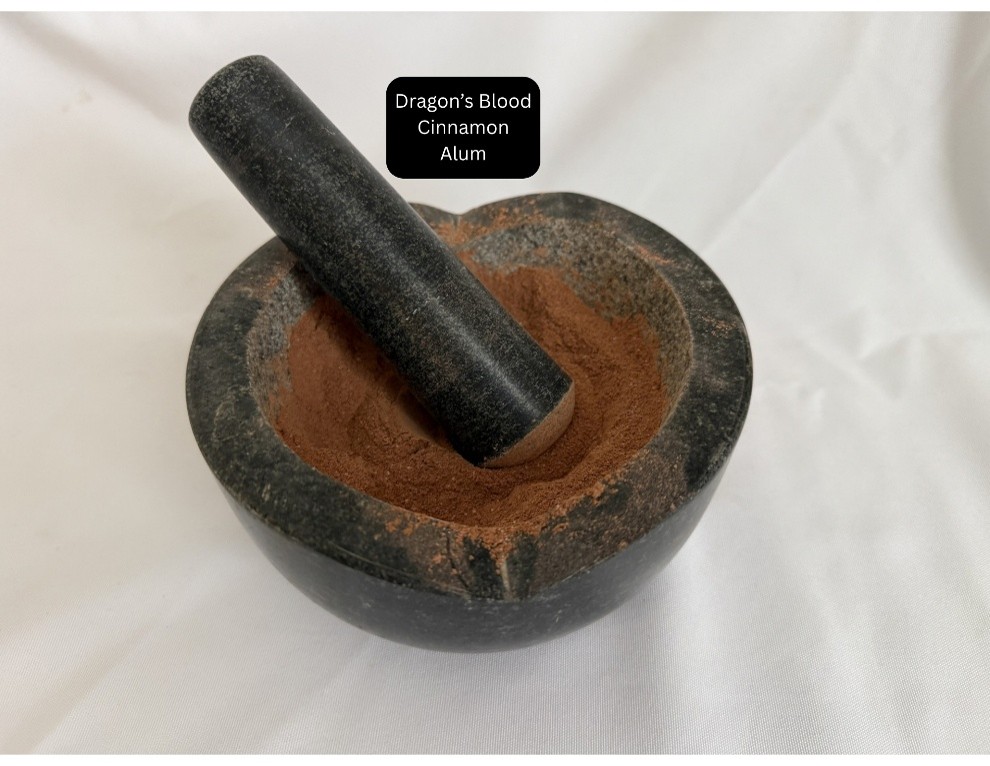
Preparation of tooth powder by grinding dragon's blood, cinnamon, and alum in mortar and pestle
Recipe
Following the directions in The Toilet of Flora, we can either rub the tooth powder onto the teeth with our fingers, or we can pair it with the miswak stick by dipping the bristles in water and picking up the powder like toothpaste. Rinse with water and repeat as needed.
Here’s why each ingredient was believed to be used:
Dragon’s Blood [8]
- Fights gum inflammation
- Protects against gingivitis
- Aids in oral tissue repair
Cinnamon [9]
- Antimicrobial
- Controls plaque
- Acts as mild abrasive
Alum [10]
- Possesses antiseptic qualities
- Repairs gum health
- Controls plaque
Results and Thoughts?
This didn’t taste like much. More medicinal than regular toothpaste you get at the store in modern times, but not totally off-putting. Cinnamon is hydrophobic, however, so rinsing your mouth out with water afterwards is a bit of a chore.
MOUTHWASH
Now that you’ve brushed your teeth with a new toothbrush and tooth powder, let’s finish off with some mouthwash, or “A Tincture to strengthen the Gums and prevent the Scurvy.”
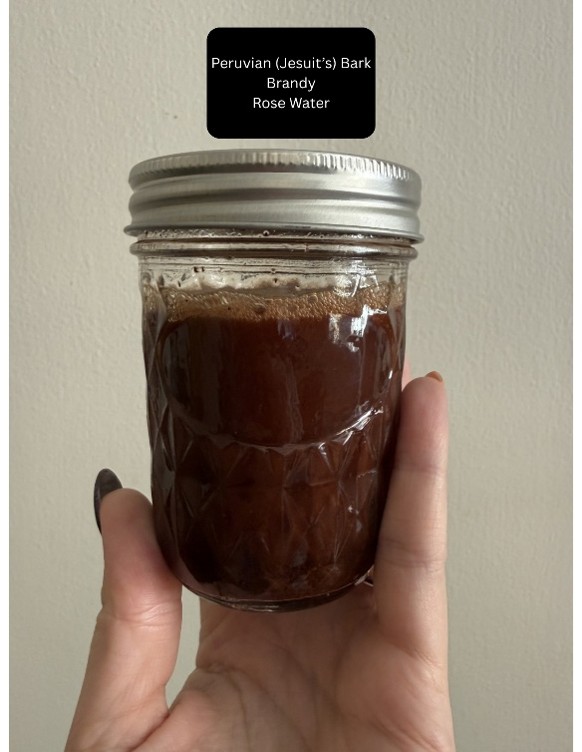
Finished mouthwash made of Peruvian (Jesuit’s) bark, brandy, and rose water
Recipe
To make the tincture, grind the Peruvian bark in the mortar and pestle and let it infuse with the brandy for two weeks. Then add equal parts rose water and mix it all together. To use, gargle with it as you would any other mouth wash.
Let’s take a look at each to see what helpful properties they were believed to bring to the table.
Peruvian (Jesuit’s or Cinchona) Bark [11]
- Antimalarial
- Throat soothing
Brandy [12]
- Antiseptic
- Tooth ache soothing
Rose Water [13]
- Anti-inflammatory
- Antimicrobial
Results & Thoughts
Absolutely not, this is foul and should stay lost to history. The ingredients don’t even make sense. Peruvian bark has high levels of quinine, which makes it an antimalarial, but only when ingested, not gurgled. Brandy is an antiseptic because it’s alcohol, but that’s different than the alcohol you find in a Listerine bottle. Alcohol for drinking dries out your mouth and prevents saliva formation, which breaks down food particles in the mouth to keep it clean. Rose water is like Peruvian bark in that it is indeed an anti-inflammatory, but again, only when ingested.
The taste is something out of a horror movie. Asking coworkers to try a brandy-forward mouthwash at 11am on a Tuesday should sound like a fun activity…it was not. Rose water and brandy do not play well with each other flavor wise, and the grittiness from the Peruvian bark was awful to try and rinse out. Thankfully, this part of the experiment was one where cameras were not present.
Final Comments
Diving into niche parts of history and recreating products that used to be commonplace is a fun way to spend the workday. Most recipes I found in The Toilet of Flora can still be replicated today if you know where to get the ingredients. [14] I recommend looking through the book yourself to see what you can make. Miswak sticks could be a good alternative to the dentist who gives out plastic toothbrushes on Halloween. But maybe stay away from the mouthwash; it’s scarier than any cavity you’ll get from too much sweets and treats.
Emily Hilbert
Manager of Public Programs
[1] "National Dental Hygiene Month," American Dental Hygienists’ Association, https://www.adha.org/national-dental-hygiene-month-2026/.
[2] “Buc’hoz, Pierre Joseph,” The Mineralogical Record, https://mineralogicalrecord.com/new_biobibliography/buchoz-pierre-joseph/.
[3] Pierre Joseph Buc'hoz, "The Toilet of Flora," Internet Archive, https://archive.org/details/toiletoffloraorc00buch/page/n9/mode/2up.
[4] Ibid, 18, 25-26.
[5] Colonial Williamsburg, "Virginia Gazette," Purdie and Dixon, November 19, 1772, https://research.colonialwilliamsburg.org/DigitalLibrary/va-gazettes/VGSinglePage.cfm?IssueIDNo=73.PD.27&page=3.
[6] Colonial Williamsburg, "Virginia Gazette," Purdie and Dixon, June 17, 1773, https://research.colonialwilliamsburg.org/DigitalLibrary/va-gazettes/VGSinglePage.cfm?IssueIDNo=72.PD.53&page=2.
[7] Mohammad M Haque and Saeed A Alsareii, "A review of the therapeutic effects of using miswak (Salvadora Persica) on oral health," National Library of Medicine, May 1, 2015, https://pmc.ncbi.nlm.nih.gov/articles/PMC4436748/.
[8] Yan-Hong Wang, Ming-Fu Ye, Fan Liu, "Effect of dragon's blood extract on periodontal tissue repair and TLR4/NF-κB signal pathway," National Library of Medicine, December 1, 2022, https://pubmed.ncbi.nlm.nih.gov/36970795/.
[9] Spartak Yanakiev, "Effects of Cinnamon (Cinnamomum spp.) in Dentistry: A Review," National Library of Medicine, September 1, 2020, https://pmc.ncbi.nlm.nih.gov/articles/PMC7571082/.
[10] BK Vanishree, et al, "Comparative Evaluation of the Effect of Alum and Herbal Mouthrinses on Plaque Inhibition in Children: A Randomized Clinical Trial," National Library of Medicine, September 1, 2021, https://pmc.ncbi.nlm.nih.gov/articles/PMC8645625/.
[11] "Cinchona," RXList, https://pmc.ncbi.nlm.nih.gov/articles/PMC8645625/.
[12] "Is Drinking Alcohol Good For Your Teeth?," Dakota Dental, https://www.dakotadental.com/patient-information/blog/since-alcohol-is-in-germ-killing-mouth-washes-is-drinking-an-alcoholic-beverage-good-for-your-oral-health/.
[13] Hsiuying Wang, "Beneficial medicinal effects and material applications of rose," National Library of Medicine, December 1, 2023, https://www.dakotadental.com/patient-information/blog/since-alcohol-is-in-germ-killing-mouth-washes-is-drinking-an-alcoholic-beverage-good-for-your-oral-health/.
[14] Pierre Joseph Buc'hoz, "The Toilet of Flora," Internet Archive, https://archive.org/details/toiletoffloraorc00buch/page/n9/mode/2up.